Upping housing quality and amenities to compete for students
More than two years after COVID-19 led to campus lockdowns and the surge in online learning, it seems higher-education enrollments and housing occupancies are at last returning to pre-pandemic levels. So says a recent article in Student Housing News titled: Post-Pandemic Mindset Fuels Reassessment of Housing Needs On-Campus (SNH, May 17,2022).
With the move back to campus solidly underway, experts in student housing are seeing not only the
relaxation of restrictions, but an actual return to “normal” campus life. However, a new mode of
thinking has overtaken campus and student-housing planners. They are now taking a much broader
look at student housing needs as a whole rather than focusing solely on deferred maintenance catch-up.
What to do with communal bathrooms
The pandemic accelerated a trend that predates the public health crisis: The shift away from large, multi-user communal bathrooms and showers. That trend originated from the need to provide greater privacy and a more “homelike” experience for residents. Students increasingly came from smaller families where they were used to greater privacy … many likely didn’t have to share a bathroom.
Common sense would lead one to conclude building new student housing communities is the most practical and efficient way to tackle the bathroom problem. In additional, the emergence of offsite modular construction of bathroom “pods” provides potentially the greatest efficiency in cost management and construction scheduling.
While renovating existing housing stock can be costly and complex, not every college or university can just tear down the old and put up the new. “In certain cases, renovations are a great way to deliver strategic upgrades to on-campus inventory with a lower cost and a much lower environmental impact than a full ground-up development,” said Gregory Danbrea, an asset management director for Harrison Street, an alternative real estate capital market firm based in Chicago.
Fighting for enrollments
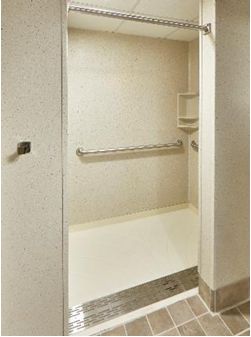
Whether renovating existing dorms or building new student housing, Inpro’s Washroom Systems division offers a full range of shower and bathroom products that look great, resist mold and mildew, and are easy to clean.
Another trend that began with the 2012/13 academic year is the decline of higher-education enrollments. This is due in large part to an overall declining birthrate. Some experts point to a veritable “cliff” coming with a considerable age demographic drop-off in 2026 and no uptick seen through 2038.
This foreshadows increasing – and potentially fierce – competition to attract students.
“University leaders recognize that fulfilling capital needs and modernizing or updating their spaces are not only about asset preservation,” said Jay Pearlman, SVP of the Scion Group.
“It’s also about preserving the competitive position of the institution at a time when revenue streams, available resources and debt capacity may be stretched thin.”
It’s obvious that being “attractive” to potential students (and parents) moves well beyond the traditional role of academics and athletics. It will accelerate the need to deliver attractive facilities, housing options and amenities. The biggest strains in sharpening their competitive edge will be felt by small-to-medium-size colleges that will increasingly fight large universities and elite schools for
enrollment share.