Introduction
In certain applications, the use of foam seals in expansion joints provides a solid seal against the elements, providing both thermal and moisture protection. Open-cell foams provide some breathability, and are best in vertical applications. Closed-cell foams are watertight and block water from entering – whether in liquid or vapor form. They are best suited to horizontal applications where moisture could remain trapped and water penetration cannot be allowed. Closed cell can also be utilized on below-grade vertical applications as support and closure to positive side waterproofing at expansion joints.
However, differences in both design and manufacturing techniques are what quickly separate seemingly similar foam seals. In some cases delamination of layered seals can lead to material failures and water infiltration.
This white paper seeks to lay out the case for monolithic foam seals, and why wax impregnation should be the specified treatment to maximize water repellency. We will also point out the differences in fire-rated foam seal systems, and the proper method for factory transitions.
Open-Cell vs. Closed-Cell Foams
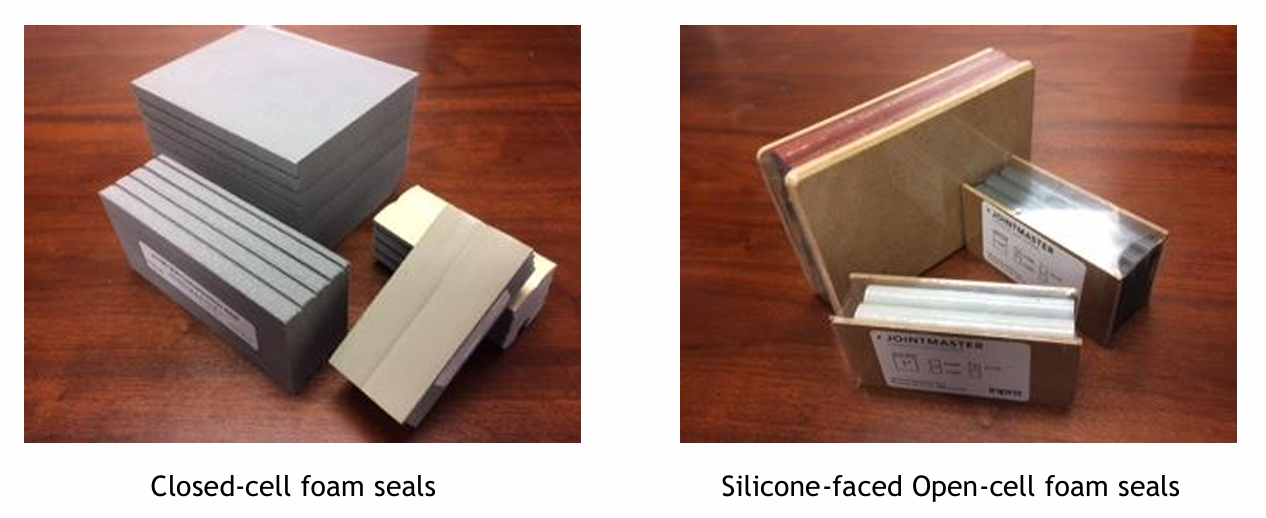
Open cell foams allow for flow-through of water and vapor. Like many exterior veneer systems, if moisture becomes trapped in a wall cavity, building systems allow the moisture to wick out. This is a good quality and a major focus to eliminate potential mold issues in vertical applications.
Closed cell foams are absolutely watertight and do not allow the moisture to enter the body of the foam. This is the best application for horizontal runs where water could pool. These are tougher to compress but can be placed under tension (or expand) well.
Laminated Foam layers vs. Monolithic Pour
Here is the comparision between Laminated Foam layers and Monolithic Pour Foam seals.
Layered foam seals
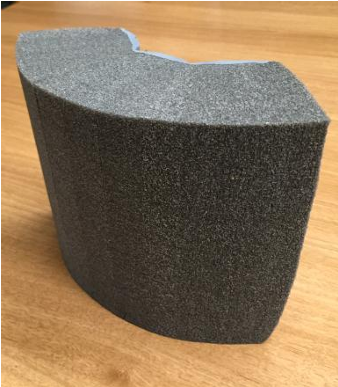
Layered foam seals are produced using sections of foam laminated together, as shown here: Laminating multiple ½" layers of foam together is a cheaper manufacturing process, but can result in a product with reduced lifecycle due to the vulnerability of:
- Delamination of the various layers from each other
- Susceptibility to splitting from shear movement
It is also important to watch out for monolithic foam lookalikes.
Monolithic Pour foam seals
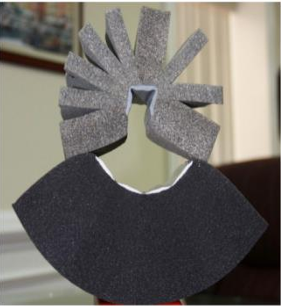
Image shows the two types of foams used in expansion joint foam seals. It seems fairly apparent that the monolithic foam has the higher overall material integrity, and in turn the greater longevity and performance needed for exposure to the elements.
Monolithic Pour foam seals are the superior alternative to the failure-prone layered seal. A pretty bold statement, we’ll grant. However, as the name implies, by producing a seal in a single pour of the foam material, there are no layers to delaminate. It’s just that simple … and in simplicity there’s superiority. You also avoid the batch-to-batch variation inherent in layered foam seals.
Examples of good foam seal installations
It’s important to note in these next two images how well the seal works with uneven substrates. The foam expands to completely fill the joint, and the two-part epoxy adhesive provides a tight seal. Any foam seals in joints over 6" (152mm) nominal width should be epoxied in place to resist sag as well as lateral and wind loads.
Waxed vs. Wax-Free Foam
Heavy wax impregnated foams that help keep joints watertight have been in use for about 50 years. However, some consider the addition of copious amounts of wax as old fashioned, and we would agree … up to a point. Today, we view a 2-3% wax impregnation as the best alternative since it drastically increases the hydrophobic properties of the foam and extends the seal’s lifespan.
So what if the specifier chooses to forego wax impregnation? Plain foam can act just like a sponge (as shown in the image below). In addition, plain foam assumes an unrealistic expectation of perfect installation of the silicone face in manufacturing and field perimeter caulk seals to keep the foam protected. If the face silicone seal itself is damaged – say, by the tip of a caulk gun jammed between the foam and wall or deck material -- leaks will occur. With wax impregnation, the foam seal will remain watertight even if the silicone face seal is compromised, in good measure because wax doesn’t dry out.
Fire Rated Foam … there are differences
There are two ways to achieve a fire rating for foam systems:
- Have the foam be totally impregnated with fire retardant
- Apply an intumescent coating or silicone on the face of the joint
The second method is, indeed, cheaper for the manufacturer. However, if vandals or an installer damages or tears through the intumescent facing, the entire fire rating is voided. The best solution is to specify a seal system the uses retardant impregnated foam.
Another difference is the addition of a Smoke Barrier between the opposing foam faces (see red arrow below). This stops smoke from penetrating on 2- and 3-hour rating requirements.
The smart way to specify Factory Transitions
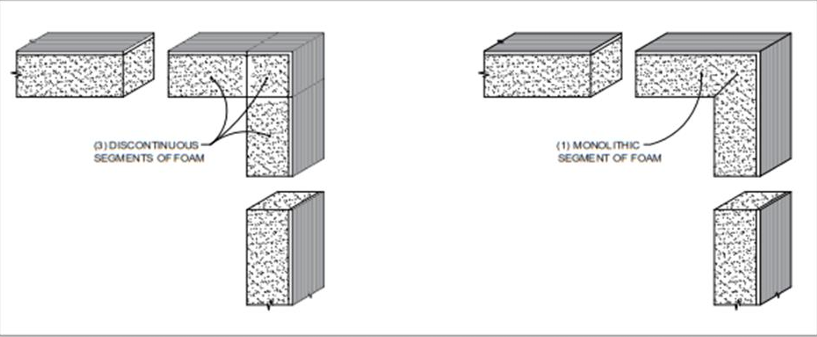
There are two distinct approaches to handling transitions in foam seals:
In Example 1 we illustrate what we call a Corner "Square" transition – a foam square is installed to fill the corner, and then slabs of foam are adhered to the corner square.
In Example 2, we show the V Notch Cut transition – the foam is cut only partially to allow a simple, non-stressing bend in the foam to fill the corner.
| Example 1: Corner "Square" transition | Example 2: V Notch Cut transition |
We recommend the V Notch Cut to our customers because we feel the Corner "square" transition introduces two distinct potential failure points:
- Three discontinuous sections of foam increases the potential for water infiltration.
- In numerous field inspections, foam sags and falls out around the "square" because the cuts compromise the foam.
Summary
As we wrap up, here are four key points to remember:
- The use of monolithic foam expansion joint seals offers superior performance for the long haul. Conversely, laminated/layered seals have greater potential to delaminate, leading to bloat, sag and total failure. Architects would be wise to specify "monolithic manufacturing methods" for foam seals, and ask manufacturers how their seals are made.
- A small amount of wax impregnation (2-3%) within the seal greatly increases its hydrophobic properties and lifetime performance.
- Specifying fire-rated foam seals with total impregnation of fire-retardant is better and safer vs. surface-applied retardant that can fail due to face damage from wear or vandalism.
- Using simple V Notch cuts in foam seal transitions vastly reduces the risk of seals either sagging or falling out entirely over time.