Introduction
Way back in 1859, the famous nurse Florence Nightingale said,
"Unnecessary noise, or noise that creates an expectation in the mind, is that which hurts a patient."
We couldn't agree more. However, we would take it a step further: Noise is also stressful and even harmful to caregivers in healthcare environments.
That was the focus of a recent webinar presented by Sara Markovitz, a principal and lead medical planner for NBBJ. The program was titled Getting above the noise: Creating High-Performance + Humane Work Environments, and is available for viewing at healthdesign.org.
In a webinar recap in the June / July 2022 issue of Healthcare Design magazine, Markovitz laid out 5 design strategies to help reduce noise levels and improve communication (we'll get to the 6th in a moment):
• Reduce the number of people who pass through patient areas by locating general use spaces along a central boulevard and not near patient spaces.
• Reduce the concentrated noise of staff outside patient rooms by decentralizing nursing and creating interaction zones throughout the unit.
• Eliminate noise from doors and carts by locating frequently used doors in internal corridors.
Continued on next page
• Use noise-absorbing materials, such as rubber flooring and fabric-wrapped panels, and shield noise producers like ice machines by strategically placing sound barriers to reduce noises that cannot be eliminated.
• Reduce as much as possible overhead paging and general alarms by using visual systems for monitoring alerts and personal communication devices.
We would add one more strategy:
Swap out traditional privacy curtain track for quieter options
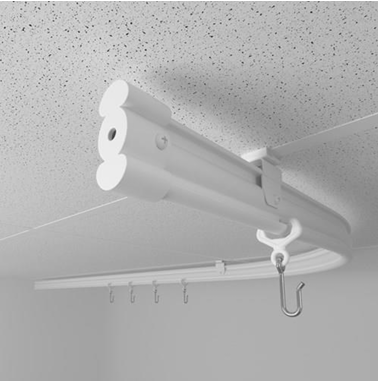
Our own experience showed that Formatrac® Bendable Cubicle Track was quieter. We could "hear" that when demonstrating the product.
However, we wanted to be scientific about it, so we tested our bendable track and measured its decibel level (dBA) against traditional track products.
The results: We found that traditional aluminum track ranked somewhere between a busy residential road (80 dBA) and the inside of a bus (90 dBA).
By contrast, we found that our new bendable track operates at the more-comfortable level of conversational speech (70 dBA).
Conclusion
We agree with Florence Nightingale and those calling to create a “culture of quiet” in hospitals. That said, there is no silver-bullet solution to reducing noise. It’s obvious a multi disciplinary approach looking across all aspects of design and material selection is needed.
Yet, we take satisfaction knowing that even privacy curtain track can be designed to help bring the “Shhhh” to healing spaces.