Introduction
The Americans with Disabilities Act (ADA) has been in place for more than 20 years, with major revisions enacted in 2010. The 2010 Standards for Accessible Design (SAD) gained teeth – compliance is now required and enforceable on the federal level.
Since the ADA views visual impairments as a disability covered under the Act, there are specific guidelines pertaining to signage products. The two categories covered under interior signage are Wall Mounted, Ceiling Mounted or Projected. Within the Wall Mounted category, Identification of permanent room signs, Directional signs, and Informational signs are covered. Within the Ceiling or Projected Mounted category, Directional and Information signs are covered.
This white paper will help you:
- Obtain a better understanding of the Americans with Disabilities Act (ADA)
- Review ADA guidelines in terms of architectural signage and variances by state
- Explain the litigation risks to building owners for non-compliance
Understanding the Americans with Disabilities Act (ADA)
The Americans with Disabilities Act of 1990 (ADA) is a law that was signed by President George H. Bush, and later amended with changes effective January 1, 2009. Its basic purpose is to protect the civil rights of people with disabilities in employment and access to goods and services. Since its inception, the ADA has had a profound affect on the sign industry.
The ADA covers a wide range of disabilities, from physical conditions affecting mobility, stamina, sight, hearing, and speech, as well as conditions such as emotional illness and learning disorders.
In order accommodate the wide range of disabilities, the ADA addresses access to the following:
- The workplace (title I).
- State and local government services (title II).
- Places of public accommodation and commercial facilities (title III).
- Phone companies must provide telecommunications relay services for people who have hearing or speech impairments (title IV).
And lastly, the ADA provides instructions to Federal agencies that enforce the law (title V).
In terms of this white paper, and how the ADA affects the sign industry with regards to how it views sight impairments, let's take a closer look at the different classifications of sight. There are four levels of visual function, according to the International Classification of Diseases -10 (Update and Revision 2006):
- normal vision
- moderate visual impairment
- severe visual impairment
- Blindness
Moderate visual impairment combined with severe visual impairment are grouped under the term "low vision": low vision taken together with blindness represents all visual impairment.
How many people have an eye-sight impairment?
The Centers for Disease Control and Prevention (CDC) define "vision impairment" to mean that a person's eyesight cannot be corrected to a "normal level." According to one estimate, approximately 10 million people in the United States are blind or visually impaired. One million adults older than the age of 40 are blind, and 2.4 million are visually impaired.
It is also important to note that over the next 30 years, as the baby-boomer generation ages, the number of adults with vision impairments is expected to double. That's approximately 20 million people in the United States who would be blind or visually impaired.
In an interesting side note – less than 2% of the visually impaired population can read Braille.
When is a vision impairment a disability under the ADA? A vision impairment is a disability if:
- It substantially limits a major life activity
- It was substantially limiting in the past (i.e., if an individual has a "record of" a substantially limiting impairment)
- An employer "regards" or treats an individual as having a substantially limiting vision impairment
What buildings are governed under the ADA?
State and Local Government Facilities
Units of government at the state, county, and local levels are subject to the ADA and must comply with the ADA Standards in new construction and alterations. All types of public facilities are covered, including schools, hospitals, public housing, courthouses, and prisons. Federal facilities are not covered by the ADA, but by an earlier law, the Architectural Barriers Act (ABA) and must meet separate, though very similar, standards.
Places of Public Accommodation and Commercial Facilities
In the private sector, the ADA Standards apply to places of public accommodation and commercial facilities. Places of public accommodation are facilities that affect commerce and that fall within twelve categories listed in the statute, including stores and shops, restaurants and bars, sales or rental establishments, service establishments, theaters, places of lodging, recreation facilities, assembly areas, private museums, places of education, and others. Nearly all types of private businesses that serve the public are included in the twelve categories, regardless of size. Commercial facilities include office buildings, factories, warehouses, manufacturing plants, and other facilities whose operations affect commerce.
Transportation Facilities
Bus stops and stations, rail stations, and other transportation facilities are required to be accessible by the ADA. The ADA also establishes standards for transportation vehicles, including buses, vans, and rail cars (which are not discussed in this guide).
Exemptions (Religious Entities and Private Clubs)
The ADA does not apply to religious organizations and private clubs, entities which historically have been exempt from federal civil rights laws. Places of worship and other facilities controlled by a religious organization, such as a school or day care center, are not subject to the ADA Standards. Private clubs may be similarly exempt depending on their exclusiveness, operations, and other factors. Facilities not subject to the ADA Standards may still be subject to state or local access codes.
Exception: Apts. & Condos
Governed by the Fair Housing Act, which requires permanent ADA-compliant raised text signage; Braille is suggested, but not required.
Increasing Litigation risk for Building Owners
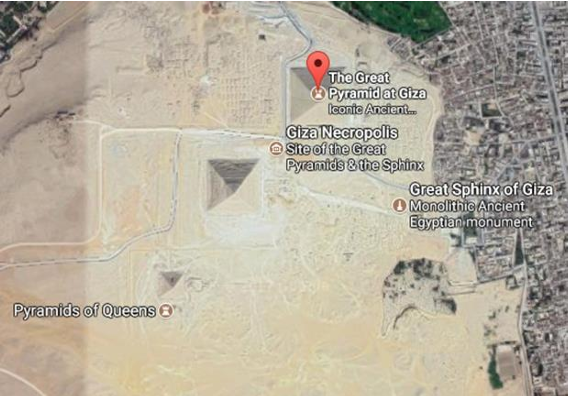
Google is a wonderful thing. In a couple clicks, we can find information on just about … no, everything. And Google Earth lets you see anything from space … like, for example the Great Pyramids of Giza shown here.
Since the creation of Google Earth, the reporting of violations has also been on the rise. Any person can zoom in on the satellite image of a business to see if there is an appropriate amount of handicap spots, or whether an outdoor pool at, say, a hotel of athletic club accommodates the disabled.
Another tactic employed by activists and attorneys to turn a profit is the “drive-by lawsuit.”
In December of 2016, the CBS new program 60 Minutes aired a segment titled “What’s a Drive-By Lawsuit?” The news segment detailed how law firms, many in California, are hiring disabled people to frequent businesses to makes sure they are up to code. If not, they file lawsuits. Because of the potential financial gain for these law firms, the businesses are usually hit up for a minimum of $4,000 in damages plus legal fees. These legal firms are cashing in on millions though as some have filed more than 2000 lawsuits against different businesses.And speaking of the rise … so is overall ADA litigation, as shown here.
Common ADA Access Violations
- Signs: outdated, missing, incorrect, wrong height, hard to find or mounted wrong
- Parking
- Access Routes: Wrong signs, blocked ramps, block passageways or uneven surfaces
- Curb Ramps
- Stairs: hazard striping, uneven steps, lighting, signage, barriers or wrong railings
- Pedestrian Ramps
- Restrooms
- Seating
- Doorways
- Exits: blocked exits or no signs showing exits
With signs being so prevalent in ADA violations, we now turn our attention to the necessary elements that make signs ADA compliant.
Types of ADA Compliant Signs
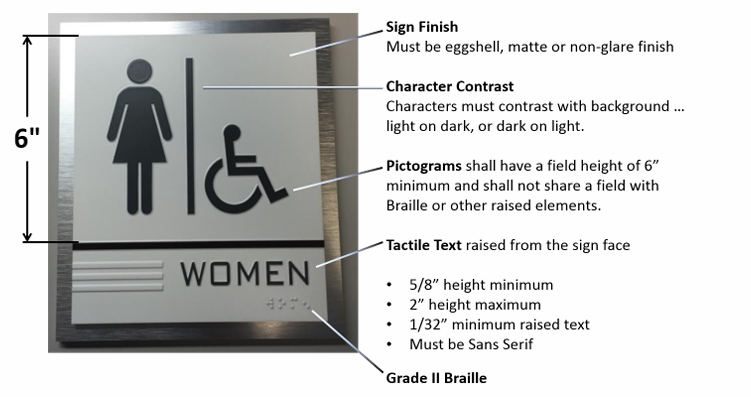
The ADA guidelines for Permanent Room Identification signs consist of three sections. Sign composition, Sign mounting and Sign finish and contrast.
A word about pictograms
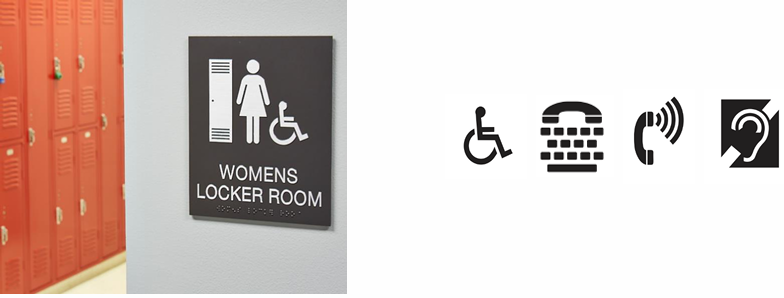
Signs can include a pictogram to help make certain rooms and locations easier to identify. They don’t rely on language, but rather usually a symbol that can be identified universally. Symbols used for accessibility are required for ADA compliance. When using pictograms, make sure that the International Symbol for Accessibility, the International Symbol of TTY (or teletypewriter), Volume Control Telephone, or the International Symbol of Access for Hearing Loss follow the guidelines set by the ADA. When using pictograms to identify restrooms and stairways, easy to understand symbols should be used. It’s important to note that local guidelines may require specific pictograms, so make sure to check with your local enforcement agency. For a complete library of available pictograms, it’s best to check with your sign manufacturer.
Dual Message Signs
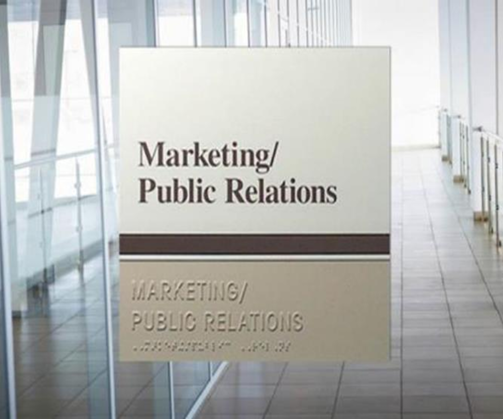
The new provision for Separate Tactile and Visual Messages is becoming more common after the 2010 ADA revisions, as the attributes that make type legible to the visual reader are different than the tactile reader.
Tactile characters shall be:
- ½” min. height
- Uppercase tactile
- Not required to contrast with background
Visual Characters shall be:
- Uppercase and/or lowercase
- Style shall be conventional in form. Simple serifs are allowed
- Stroke thickness shall be 10 percent minimum and 30 percent maximum of the letter height
- Spacing between characters shall be 10 percent minimum and 35 percent maximum of the character height.
- Minimum character height is 5/8”, providing height above flor is below 70 inches and minimum viewing distance is 6 feet or less.
In the next section, we’ll cover mounting requirements.
Mounting Requirements
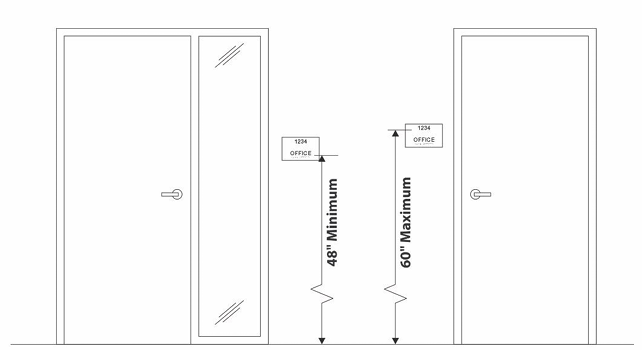
As you can see in this illustration, the Room Identification sign must be mounted on latch side of door.
Must be 48” minimum from the finished floor to the base of the characters, or 60” maximum to the top line of text.
Braille Requirements
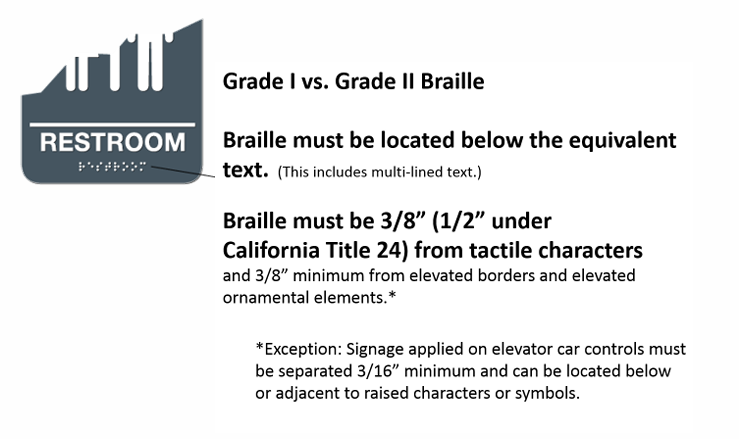
Now that we learned about the ADA requirements for Room Identification sign composition, sign mounting, and sign finish, we will take a closer look at Braille requirements.
ADA regulations require Grade II Braille. Grade II Braille allows for abbreviated text. For reference, Grade I Braille is a letter for letter translation.
The ADA guidelines state that Braille must be located below the equivalent text. (This includes multi lined text).
Braille must be 3/8” from tactile characters and 3/8” minimum from elevated borders and elevated ornamental elements.*
*Exception: Signage applied on elevator car controls must be separated 3/16” minimum and can be located below or adjacent to raised characters or symbols.
We also want to delineate that California Braille differs from federal (ADAAG) Braille only in the dot spacing. The use of California standards for Braille satisfies both Federal and California regulations, allowing a single dot configuration for all Braille signs nationwide.
Now, let’s look at Directional and Informational signage.
Overhead Directional and Informational Signage
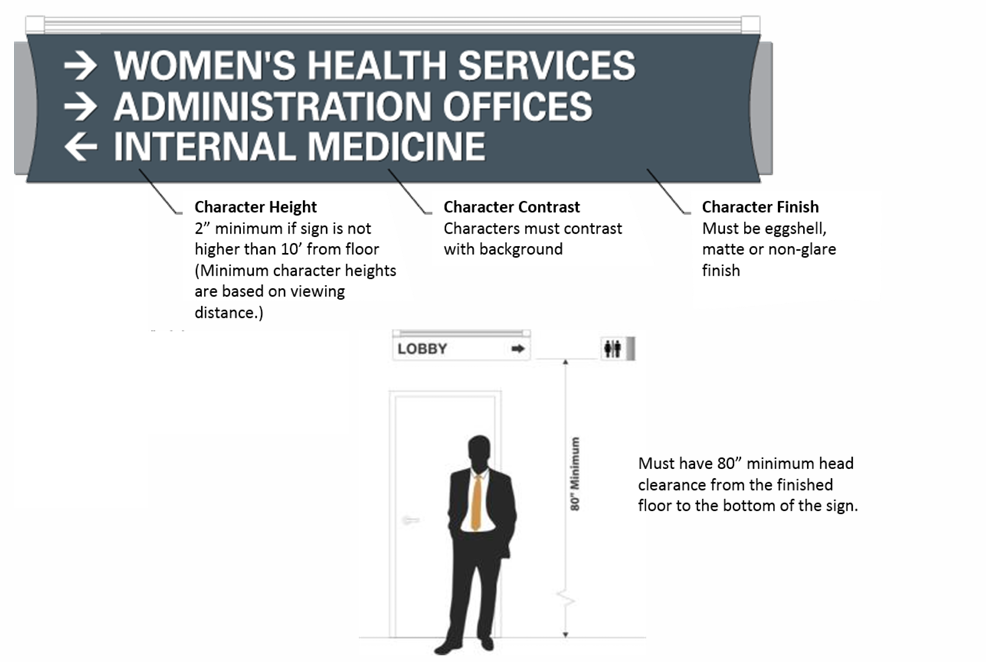
Current ADA Guidelines
Sign Composition:
- 2” character height minimum if sign is not higher than 10’ above the floor. (Minimum character
heights are based on viewing distance.) - Does not need Braille
Sign Mounting:
- Must have 80” clear space from floor to the bottom of the sign.
Sign Finish and Contrast:
- Characters must be eggshell, matte or non-glare finish.
- Characters must contrast with background.
A final word about State statutes and codes

It’s important to note that several states may have additional code provisions regarding accommodation. Any state, county or municipality may modify their building codes affecting signage as long as they have been granted approval by the Department of Justice. These codes are then enforced by state and local officials.
Regardless of the level of government, all must comply to the federal ADA at a minimum – that is, states, counties and municipalities may only deviate from the ADA only if the change or standard is more strict than the federal law.
It’s best to check with the local authority with jurisdiction in your project’s site.