Addressing the growing need for greater capacity through temporary hospital setups and within current hospital spaces
Current efforts in the U.S. are aimed at suppressing the spread of the COVID-19 virus through social distancing and limited interaction (e.g., work from home, etc.). The hope of taking these protective measures is to “flatten the curve” of patients needing inpatient treatment at the nation’s hospitals to not surpass the capacity of the healthcare system and to reduce the number of cases altogether.
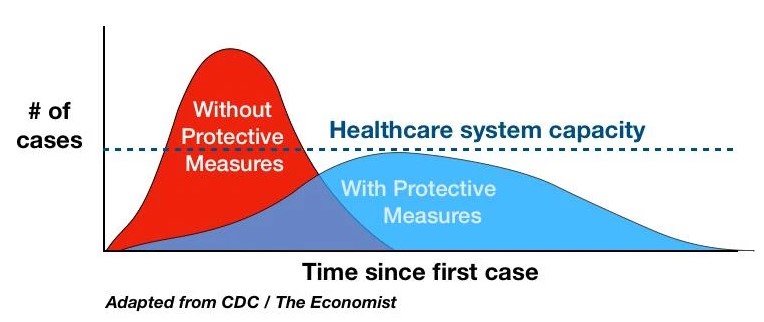
There are approximately 95,000 critical care beds in the U.S. Should U.S. COVID-19 infection rates reach levels seen elsewhere in the world, the potential would be at least double the number of beds needed to treat the most-severely affected. This is where the need for field hospital or other temporary hospital circumstances need to be considered.
Is your facility ready to meet the cleanliness demands of our new normal? Download our checklist: Key Considerations for Designing Healthcare Facilities.
Using alternative spaces for surge hospital solutions
A real possibility is the establishment of surge hospitals and the creation of field hospitals to handle the increased influx of potential patients. Per a guidance document from the Joint Commission, several facilities could be pressed into service, including:
- Shuttered hospitals and wards
- Facilities of opportunity – e.g., veterinary hospitals, convention centers, exhibition halls, empty warehouses, airport hangars, college dorms, sports arenas, or hotels.
- Mobile hospitals – e.g., an 18-wheeler truck fitted with surgical and intensive care units.
- Field hospitals or portable facilities, commonly called a “hospital in a box”
Increasing current hospital capacity to accommodate an emergency situation
Per the American College of Physicians …
It may be necessary to use innovative approaches, such as converting single rooms to double occupancy; expediting discharges; slowing admission rates; and converting spaces like catheterization laboratories, lobbies, postoperative care units, or waiting rooms into patient-care venues.
An example from Michigan Medicine … Contingency plans have been developed, including activation criteria for opening a respiratory intensive care floor where cohorting of both critically ill and non-critically ill patients can occur.
If the experience in Northern Italy is any indication, additional inpatient space had to be created by conversion of other spaces within the hospitals:
Now, nearly all operating rooms in the Lombardy region have been converted into intensive care units, said Giacomo Grasselli, the intensive-care coordinator at Milan’s Policlinico hospital.
Source: Reuters.
In addition to isolation and cohorting at medical centers, hospital triaging routines will likely have the diversion of less-than-critical patients to primary care doctors at outpatient facilities and clinics. Thus, these facilities will need protocols to isolate COVID patients – both while they wait and in treatment.
Caring for seniors, being some of the most-vulnerable to the COVID virus, will mean skilled nursing facilities and assisted living operations will also need to have plans in place to isolate and/or cohort COVID-19 residents. Again, hospital triaging and capacity limits may indicate that less-critical seniors would be treated at their home facility.
Creating individual patient or resident spaces
First off, we will acknowledge that – in an ideal scenario – there would be adequate numbers of Airborne Infection Isolation Rooms (AIIRs) with tested effectiveness for air exchange, negative pressure and exhaust handling. However, it seems clear from the various outbreaks around the globe that AIIR capacity in the United States could be fairly quickly used up.
Aside from AIIR considerations, healthcare and senior care facilities staff planning to convert other spaces to isolate and house patients or residents, may include:
- A single patient or resident room is divided to house two people
- A senior living facility converts its library to cohort COVID-infected residents.
- An orthopedic wing converts its waiting room to house some quantity of inpatients.
- An operating room is converted to handle four or six patients.
- A hotel ballroom becomes a “ward” to cohort patients
These solutions require dividing up space into individual segments or cubicles to provide at least some level of privacy and isolation for the patient or resident. While more of a temporary measure, it answers the need to create more patient treatment areas and resident spaces in a short amount of time.
Now more than ever, the need for more beds in hospitals is in high demand. While there are a number of ways to increase capacity, the race against time to prepare for the uncertain and unprecedented situation to come is certainly a challenge.
Learn more about solutions for creating temporary healthcare spaces.